Kolte Patil FY26: Record Collections, a Net Loss and What Bangalore Buyers Should Take From It
A company can bank more cash than ever and still show a loss on paper. Kolte Patil Developers did precisely that in FY26, the twelve months ending 31 March 2026. This explainer unpacks why the two happened together and what buyers in Bangalore can take away from it.
Two Headlines That Seem to Clash
Buyers handed Kolte Patil more money than in any earlier year, yet the profit and loss statement closed in the red. Cash and profit are measured on different clocks here. The cash clock follows instalments, while the profit clock follows completed projects.
The company is listed, has its base in Pune and runs projects across Bangalore, Mumbai and Pune. Figures on what was sold and collected came out in April 2026, while audited accounts arrived on 22 May 2026, and the table puts the full year beside its closing quarter.
| Collections | Sales | Average price per sq ft | Operating revenue | |
|---|---|---|---|---|
| Full year FY26 | Rs. 2,689 Crore | Rs. 2,605 Crore | Rs. 8,314 | Rs. 734.96 Crore |
| Quarter ended March 2026 | Rs. 834 Crore | Rs. 714 Crore | Rs. 9,601 | Rs. 248.61 Crore |
FY25 collections were Rs. 2,424 Crore, so FY26 grew by 11% to a company high. In the final quarter, sales climbed 13% and collections 18% against the same period a year earlier. That quarter's average price was 21% above the previous year and also a high.
Operating revenue moved in the opposite direction. It was Rs. 1,717.38 Crore a year earlier and Rs. 734.96 Crore in FY26, a drop of more than half. A net loss was posted for both the last quarter and the full year, whereas the previous year had closed both periods in profit.
How Completion-Based Accounting Creates the Gap
The company's accounting follows the completed contract method. A home's price becomes income only on the day the project is complete and the keys change hands. Instalments received before that are kept as advances from customers.
As a result, sales and collections respond to market demand, while revenue responds to when buildings are handed over. When few buildings finish in a year, revenue stays low despite healthy sales and punctual payments. Overheads continue regardless, so thin revenue can tip the year into a loss.
FY26 fitted that pattern. Compared with FY25, fewer buildings were finished, and revenue shrank by over half. Homes sold this year will enter the income statement later, project by project.
What a Buyer Should Watch Instead
People buying an unfinished home want to know whether the developer can pay to complete the building. Collections speak to this more directly than profit, since they measure cash received to fund construction. Rising collections with steady sales suggest buyers pay instalments on time.
Profit deserves a long-run look. A loss that merely reflects when buildings complete is not the same as one produced by soft sales or high interest charges. The latter tends to appear as shrinking collections and climbing debt, and neither shows in the FY26 numbers above.
Blackstone as a Shareholder
The global investment firm Blackstone has a stake close to 40%, after joining as the company's strategic partner in FY26. An institutional owner of that size generally brings stricter financial discipline and easier access to funds. In the same year Bhugaon in Pune brought new projects into the portfolio, carrying a gross development value near Rs. 2,250 Crore.
FY26 also brought a leadership transition alongside the new partner. A strong shareholder reassures at the company level, though it cannot substitute for checks on the particular tower where a home is located.
Bangalore Projects
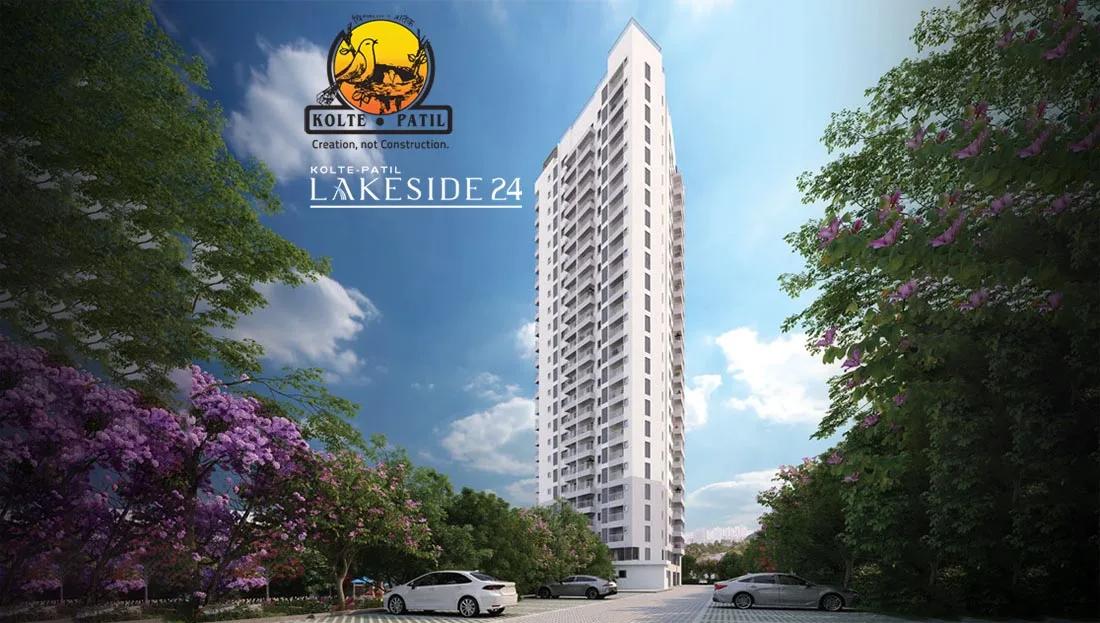
Of the three cities, Bangalore is the smallest for Kolte Patil, and Pune generates most sales. Electronic City, Horamavu and Koramangala all have finished projects. Meanwhile Kolte Patil Lakeside 24, off Hennur Road within the Thanisandra belt, is being built, and possession is planned for October 2028 onwards.
Published figures cover the whole business with no city split. They reveal little about the funding or progress of a single tower in the city, which is better judged from the tower's own regulator filings and quarterly updates.
A Short Guide to Any Developer's Results
Listed builders publish results every quarter, often following an operating update released a few weeks before. The items below carry most of the useful signal.
- Whether collections are climbing or sliding across several quarters
- The value and area of homes sold, a gauge of demand
- Which accounting method governs the moment a sale becomes income
- Borrowings net of cash, and the debt-to-equity ratio
- Operating cash flow, to see whether the business funds its own construction
- Delivery updates on live projects, measured against RERA dates
One quarter is a small sample, so a lone loss or a lone high says little. Looking at four to eight quarters in sequence reveals the real direction.
Checks That Apply Whatever the Results Say
Company results are the backdrop, and checks for the home itself do not change from builder to builder. Ask our team for today's rate cards and unit availability in Kolte Patil projects around Bangalore, each with its RERA details.
- Find the project's RERA number and promised completion date on the state RERA site
- Set its quarterly progress updates against progress observed at the site
- Find out whether the developer owns the land or has taken it on a joint development basis
- Ask for carpet area, an itemised cost sheet and the payment schedule, all in writing
- Read the clause on compensation for delay in the draft sale agreement
- Tour a Bangalore project the developer delivered in recent years
- On a finished home, ask the seller for khata papers and the occupancy certificate